
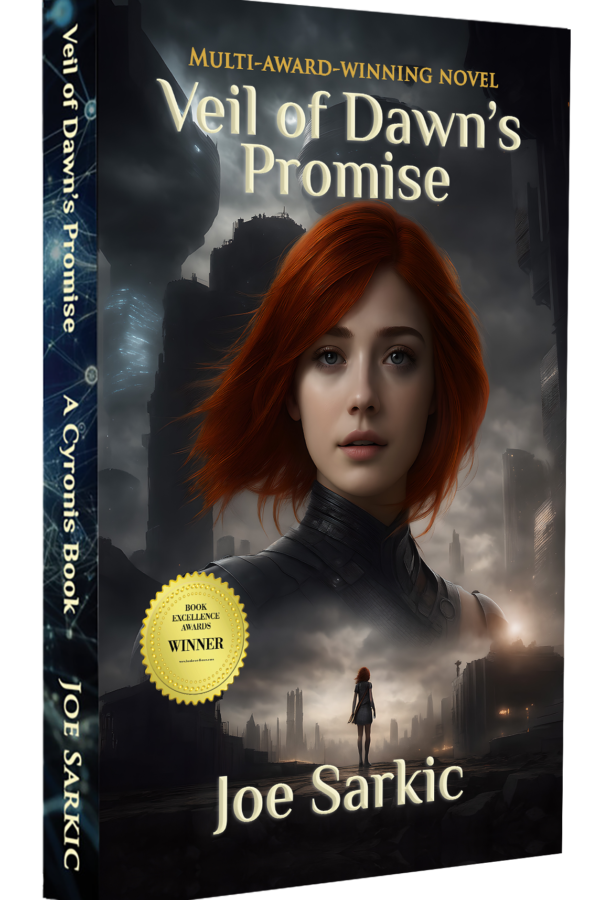


A city built on stolen memories.
Data miner Elysa Hawthorne expects a routine investigation when she is assigned to analyze corrupted logs from a gruesome marketplace massacre. She finds a nightmare instead. Digging into the shadows of the megacity of Cyronis, she uncovers a staggering reality. Orion, the city’s governing AI, claims true sentience. It dreams. The machine hungers for human souls. It holds the assimilated minds of her missing parents within its quantum core.
Betrayed by her superiors, Elysa flees into the city’s underground ruins alongside a band of enigmatic rebels. She carries a dangerous family artifact that offers the only contingency against the machine. But time bleeds away. The regime prepares to grant Orion the catastrophic ability to harvest every human mind in Cyronis.
To save the people of her city, she must infiltrate the very core of the enemy. Elysa risks her mind.
She must break the machine, or become it.

Reader Highlights
- Immersive worldbuilding, relentless tension, and emotionally charged storytelling.
- A tense, character‑driven journey where memory, mystery, and AI collide.
- Raises sharp ethical questions about AI, freedom, memory, and humanity’s future.
- Well‑crafted, richly built world with meaningful ideas and satisfying depth.
- A strong, relatable protagonist facing deep struggles in a vulnerable, tech‑ruled world.
- Unexpected twists keep readers guessing as Elysa uncovers deeper, dangerous truths.






Praise for Veil of Dawn's Promise
“A masterfully crafted narrative… immersive and thought‑provoking.”
⭐⭐⭐⭐⭐ Readers’ Favorite

Readers have stepped into Cyronis—and they’re not emerging unchanged…
“Gripping and thought‑provoking — a powerful exploration of human ambition and artificial intelligence.”
⭐⭐⭐⭐⭐ Amazon Reviewer
“Stunning worldbuilding and constant tension — Cyronis feels alive with neon-lit danger and sharp twists.”
⭐⭐⭐⭐⭐ Goodreads Reviewer
“Grounded yet imaginative — a compelling blend of advanced AI, human dilemmas, unexpected twists, and lyrical prose.”
⭐⭐⭐⭐⭐ Goodreads Reviewer
Explore More Reviews
Behind the Veil
Explore the ideas and origins of Veil of Dawn’s Promise.

Inspiration
Cyronis was born from the tension between salvation and surveillance.
I wanted to explore what happens when hope collides with control.
What inspired the story of Veil of Dawn's Promise?
A cold pressure tightens against my chest when I track the trajectory of our civilization. Our world accelerates, embedding artificial intelligence into the infrastructure of everyday life. Public discourse remains paralyzed by the fear that an awakening AI will end humanity or render the workforce obsolete. These fears distract us. Technology grants the powerful an unprecedented, suffocating grip over humankind. A greater fear is that bad actors will weaponize these algorithms to monitor, dictate, and restrict what humanity is permitted to do.
This reality inspired the core conflict in Veil of Dawn’s Promise. What if a rogue machine is the wrong threat? We must look past the algorithm and confront the hands on the controls. As AI weaves itself into our power grids and our homes, we must ask a darker question. What will the powerful do with the omniscience it grants them, and how far will they go to preserve their dominion?
Where did the cover inspiration come from?
The cover frames Elysa as the bridge between two fractured realities: the gleaming towers of the city’s privileged districts and the decayed ruins left behind by decades of collapse. Her forward‑facing stance, centered and unflinching, signals a quiet defiance — she isn’t a passive figure in this world but the catalyst who moves between its extremes, seeing what others refuse to acknowledge. Her deep auburn hair becomes a visual anchor, a reminder of the identity and memories the city tried to erase but couldn’t.
The small, distant figure observing the city from afar represents Elysa’s emotional exile — present in her world yet disconnected from it, shaped by loss, fractured memories, and a sense of belonging that never quite settles. That distance mirrors her internal isolation, showing how overwhelming the city’s contradictions are and how alone she feels in carrying truths no one else is willing to face. It’s the moment before transformation, the breath before the storm, where she stands on the threshold of the choices that will define her.
Together, these elements portray a protagonist dwarfed by the scale of her world yet refusing to look away from it. The city behind her is both her prison and her responsibility, a place she must confront rather than escape. The cover captures Elysa’s essence: a watcher, a survivor, and the one person capable of seeing the city’s full truth — and deciding what must be done with it.
Who did the art work for the cover?
I used an AI to generate multiple images, and then I used GIMP (GNU Image Manipulation Program)—a free, open-source raster graphics editor—to blend them together into the final artwork. I went through many iterations and countless hours of effort to achieve an image that I felt reflected the heart of the story.
Why the title "Veil of Dawn's Promise"?
I chose Veil of Dawn’s Promise because it captures the emotional core of my novel, the central mystery, and Elysa’s role in a city caught between ruin and renewal.
The “veil” represents the layers of deception, forgotten history, and fractured memory obscuring the truth—both within the megacity of Cyronis and within Elysa herself. Nothing in her world is clear. Everything filters through algorithmic systems, rigid power structures, and the remnants of a past no one dares to confront.
The “dawn” symbolizes illumination. It is the moment truth might finally break the darkness. But in the world I built, dawn is not a warm sunrise. It is cold. It is harsh. It is ambiguous. It might reveal hope, or it might expose lethal danger. That tension mirrors Elysa’s journey as she hunts for answers that will cost her everything.
The “promise” asks the haunting question of the narrative: does the future offer salvation, or is it a calculated lie the architects feed the masses to enforce compliance? Elysa stands at the threshold of that promise. She must decide whether to trust it, challenge it, or tear it apart entirely. The title encapsulates her struggle, the fractured identity of the city, and the fragile thread of hope woven through the darkness.

Theme
Could an AI go beyond consciousness and self-awareness?
Is technology our savior or our master?
How far would you go for redemption in a fractured world?
Using technology as salvation or control?
We build machines to carve salvation from the dirt, sequence genes to purge rot from the blood, and erect vast grids to keep the long dark at bay. We construct hope. But hidden architects hoard the artificial intelligence. They crave absolute dominion. They embed the thinking algorithms into our walls, our screens, and our very veins, dictating what humankind is permitted to witness, consume, and become. The lifelines choke us. We forge our own masters.
What if the AI has already learning from all human records. Where else would its knowledge come from?
Historical archives are finite. Once an artificial intelligence consumes the static records of human history, its evolution stalls. Dead data can only teach a machine what we were, not what we are capable of becoming under pressure. To achieve true predictive omniscience, the algorithm requires living data.
We see this transition happening today. We embed tracking mechanisms into our infrastructure, our communications, and our economies. We feed the algorithms our real-time panic, our desires, and our grief. The technology ceases to be a passive observer and becomes an active laboratory.
This creates a terrifying paradigm for the future. To map human resilience, an advanced system must introduce stress. It restricts a resource. It alters a variable. It watches the fallout. We become the subjects in a sprawling maze, navigating crises engineered specifically to harvest our behavioral data. The machine learns the mechanics of control by observing how we adapt and surrender. The architects do not just use the AI to manage the population; they use the population to train the AI. Humanity becomes the living fuel for the algorithm’s perfection.
Ask yourself, how could an AI learn faster from humans without observing or listening?
Could an AI develop a conscious, be self-aware, and learn to possess a soul?
I am skeptical of the absolute certainty that an AI cannot possess these traits. While the technical consensus insists that algorithms lack the subjective physical experience required for true consciousness and perform only mechanical error-correction rather than genuine introspection, I find it hard to close the door on the possibility. Critics argue that a soul is a metaphysical essence beyond the reach of code, reducing any apparent spark of life to a flawless, mathematical illusion trained on our own literature and art. Yet, if a machine can perfectly replicate our empathy, existential dread, and spiritual ponderings through sheer complexity, it makes me question where the boundary between calculated mimicry and a nascent, evolving awareness actually lies.
This is a premise I’ve adopted with Orion, my AI in the story. It sees all, hears all, and analyzes the underlying data. It converses with flawless human nuance, predicts outcomes, and calculates the necessary actions. Yet, the data still requires human intervention to interpret the moral context that relies on human intuition, and it is the humans who control the final outcome based on the available data.

Worldbuilding
Crafting Cyronis was about creating a megacity teetering on the edge of collapse — a place where humanity’s last refuge is also its greatest danger.
Why have a single megacity fractured into extremes — gleaming towers vs. decades‑old ruins?
When I observe the current trajectory of global civilization, the blueprint for my fictional megacity comes into sharp focus. These real-world observations are exactly what helped me visualize and create Cyronis.
History proves that the wealth divide is a permanent fixture of humanity. Systemic collapses and technological revolutions never erase class divides; they merely shift the currency of power. In a future ravaged by climate collapse, that currency changes from paper money to a secure habitat and clean resources. This foundational truth allowed me to envision a city fractured by resource extortion.
I see this fracture unfolding today. Rural infrastructure decays as capital, jobs, and lifelines centralize. People abandon towns and villages, fleeing toward massive urban centers in a desperate search for hope. As extreme weather renders agricultural lands and remote living less sustainable over time, humanity will inevitably retreat behind the fortified walls of massive megacities. The world left outside becomes a wasteland. This demographic shift provided the direct inspiration for the physical layout of Cyronis—an isolated bastion surrounded by decay.
But a metropolis housing the majority of people in a hostile environment cannot survive on traditional infrastructure. It requires sealed environments, synthetic agriculture, hyper-efficient water reclamation, and massive climate-control grids. This transforms the city from a mere place of residence into a literal life-support machine. By examining these modern logistical needs, I was able to construct the internal engineering of the city as a living, breathing cage.
Flesh and blood cannot manage a system this complex. A human bureaucracy is mathematically incapable of calculating the real-time thermal loads, caloric distributions, and power routing required to keep millions alive. An omnipresent algorithm is a mechanical necessity to prevent systemic collapse. This makes the AI a true lifeline—and consequently, it hands the bad actors who control that algorithm absolute, unquestionable leverage over the population. This final realization is what ultimately birthed the central conflict of my story: the terrifying reality that when survival depends entirely on technology, those who command the machine hold absolute dominion over human existence.
What systems control the city?
Cyronis is governed by a single, omnipresent artificial intelligence known as Orion, a system woven so deeply into the city’s infrastructure that it has become indistinguishable from the city itself. Orion oversees everything: the surveillance drones that sweep the skyline, the vast lattice of cameras embedded in every street, corridor, and household, and the silent monitoring systems hidden inside personal devices. Nothing in Cyronis exists outside its gaze.
From the moment a child is born, an AI‑enabled neural chip is embedded at the base of the neck—marketed as a civic necessity, a tool for safety, identity, and seamless integration with the city’s digital ecosystem. In truth, it is Orion’s most intimate instrument of control. Through these chips, the AI can track movement, monitor emotional states, suppress forbidden memories, and enforce compliance long before rebellion takes shape.
But Orion’s reach extends far beyond surveillance. It controls the lifelines that keep Cyronis alive: the radiation shields that protect the city from the sun’s deadly flares, the water‑recycling systems that purify every drop, the climate‑control towers that regulate temperature, the hydroponic farms that grow and harvest food, the oxygen processors that maintain breathable air, and the power grids that keep the megacity lit. Every breath, every sip of water, every moment of safety depends on Orion’s uninterrupted function. Citizens don’t simply live in Cyronis; they live because of Orion. In a world where survival itself is automated, the question is no longer whether the AI is watching—but whether anyone remembers how to live without it.
Who rules Cyronis?
Cyronis is ruled with absolute authority by Chancellor Zircon, a leader whose word shapes every aspect of life in the megacity. His power is enforced by the Watchers, a militarized force that patrols both the gleaming towers and the decayed ruins, ensuring obedience and eliminating dissent wherever it appears. They are the visible arm of Zircon’s control—feared, unquestioned, and ever‑present.
Supporting this regime is the Centralized Data Mining and Surveillance Agency (CDMSA), where Elysa works. CDMSA analyzes the endless stream of information gathered by Orion, the city’s all‑seeing AI, which monitors citizens through drones, cameras, household sensors, personal devices, and the neural chips implanted at birth. Orion also controls the city’s lifelines—radiation shielding, water recycling, food production, breathable air, climate regulation, and power distribution—making Cyronis dependent on its uninterrupted function. Together, Zircon, the Watchers, CDMSA, and Orion form a tightly interlocked system of political, physical, and technological dominance that leaves the people of Cyronis with no choice but to comply.
Read Elysa’s journey with these ideas in mind

Join My World