
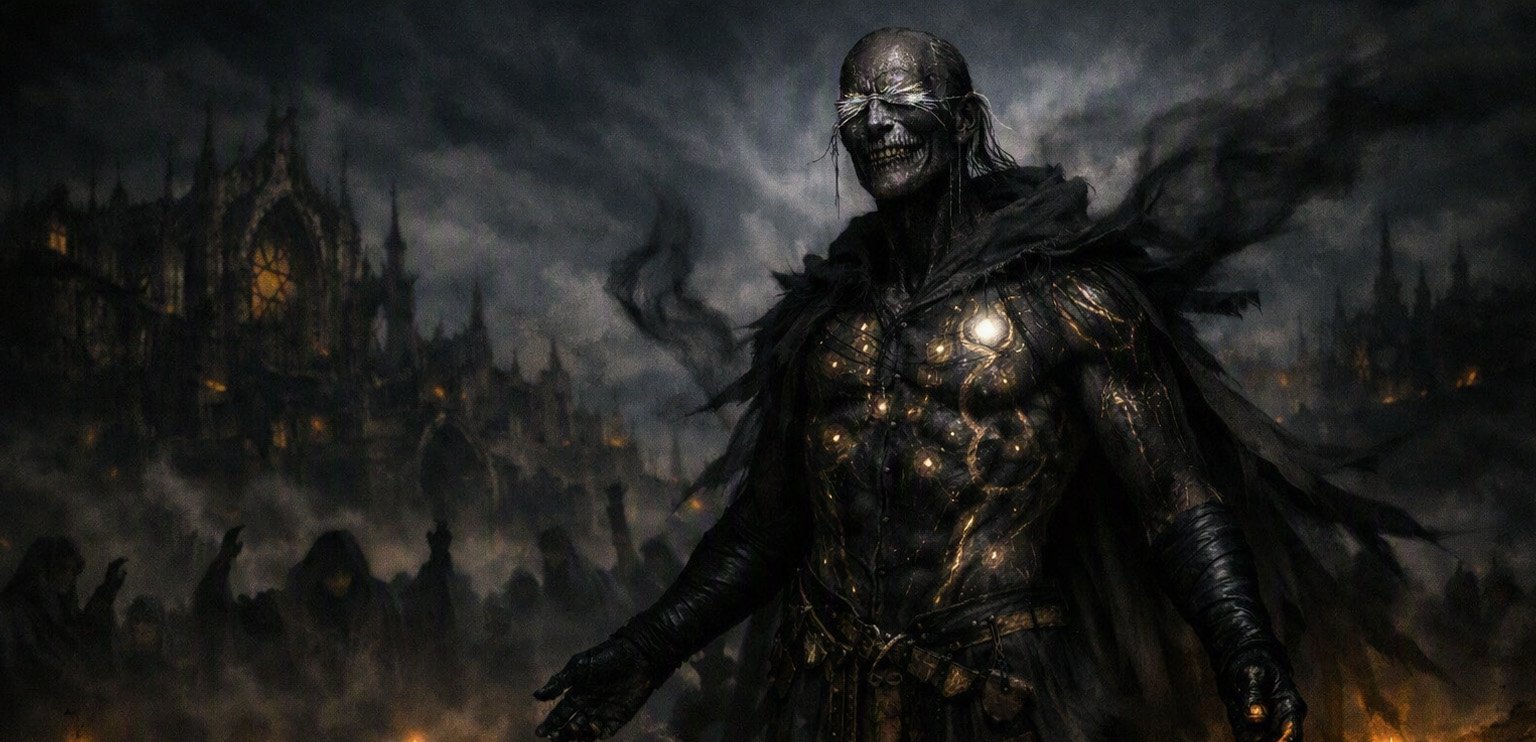
In a world where death is not an end but an industrial engine, the true measure of the Necrocracy’s terror lies in its monsters. Driven by the philosophy that life, bone, and divinity are merely raw materials to be harvested, the empire deploys a horrific menagerie of void-born entities, reanimated horrors, and twisted beasts.
1. The Demons
At the head of the invading host stand the supreme demons of the Void:
- The Profaner: A towering, skeletal god-husk draped in the shredded, oversized relics of a shattered deity. Its hollow ribcage imprisons a thrashing, unseen skeleton, and its rusted iron face features a fused-shut mouth that whispers mind-scraping words. It acts as the walking engine of the Necrocracy, bleeding stagnant amber light from its mask to create a brutal, invisible tether that forces the fallen dead forward as cooperative masses of bone.
- The Scism-Wright: A chilling horror clad in blackened armor that ripples like molten night. With a cold purpose burning in its twin-star eyes, it carries no physical blade; instead, the air around its hands warps and bleeds, turning reality a sickly, mottled purple wherever it reaches.
- The Ashwing: A colossal corruption of a dragon—a cathedral of suffering whose wings are made of fractured, smoke-slick bone with twisted ribs extending outward like spires. Rather than breathing flame, its unhinged maw unleashes a silent, staggering hunger that unmakes history and rots living trees instantly into ash.
2. Void-Constructs and Abominations
- The Siege-Beast: A massive Void-construct of stitched leather and jagged metal that stalks on six mismatched limbs. Standing twice the height of a Stonemane, this engine of destruction possesses a knotted mass of muscle and void-forged iron capable of casually batting heavy cavalry aside like stray dogs.
- Void-Hulks: Towering slabs of muscle and midnight-blue scale dredged from the deepest trenches of the abyss. They breathe with the grinding sound of cracking glacier ice, emitting a freezing mist and a chilling aura that breaks walls rather than relying on speed.
3. Specters of the Dark
- Shadow Wraiths: Hollow silhouettes of tattered shadow that can swarm solid stone and ignore iron. Serving as specialized infiltration units, they drift like funeral soot, trailing silent vaporous chains that freeze the air and bring the scent of ozone before dissolving into fine grey ash when unmade.
- Ice Wraiths: Skeletal abominations wrapped in tattered shrouds that carry supernatural winter, flash-freezing organic matter upon contact.
4. Field Predators and Mounts
- Stonemanes: Massive, bison-like mounts bred in the volcanic highlands of Grah’duhm. Cliff-bodied and broad across the withers, these 800-stone juggernauts carry dense muscle beneath plates of calcified hide and basalt-shelf backs. With jagged obsidian bristles along their spines, ember-red eyes, and spear-length curved tusks, they move with a tectonic, ground-pounding weight, smelling heavily of caked mud and crushed rock.
- Murk-Hounds: Swamp-born tracking beasts with wet, taut skin, algae-like fur, and root-hardened hook claws. Possessing midnight coats, bone-white scars, and void-star eyes, they flare their nostrils to read scent like a language, moving with a silent, stagnant hunger that vibrates through soil and roots.
5. The Walking Dead
- The Damned Thrals: Mangled, slack-jawed corpses with limbs twisted at grotesque angles. Their rust-cankered armor clings to bone beneath scavenged weapons, and their hollow eye sockets burn with sorcerous fire—some violet, some the color of old blood—surging forward in a collective spasm of violence under the Necrocracy’s command.
The Environment as an Active Antagonist
In Necrocracy, the physical world is not a passive backdrop for the characters to traverse—it is an active, hostile participant that judges, traps, and wears down the living.
- The Rotting Forests: The landscape is choked by ancient, petrified timber and blackthorn brambles that weep dark, gore-like sap when disturbed. The air tastes of sulfur, scraped flint, and marrow-deep cold.
- The Weeping Stone and Turning Wards: As travelers cross into The Edge, the yielding moss vanishes, replaced by loose grey shale, stark dusk, and stark, stunted white-bark trees. The environment uses turning wards to fold paths back onto themselves, psychological and physical traps that actively resist intrusion until a toll is paid.
Why Environmental and Monster Design Matters
When a being is unmade by high-tier magic, they aren’t just dead—they are scrubbed from the loom of history. This creates a psychological horror element called Erasure Sickness:
- Witnesses suffer immediate memory loss of the victim, leading to physical symptoms like vice-like headaches, cranial pressure, and nosebleeds as their minds desperately rationalize the void.
- Only the wielder retains the memory, bearing the crushing, isolated burden of truth alone.
Joe Sarkic writes award‑winning grimdark fantasy and science fiction, crafting atmospheric tales of haunted realms, fractured megacities, and the people who survive them. Step into Veil of Dawn’s Promise and Necrocracy: Forsaken Guardian to explore worlds where both sorcery and technology demand a price.
Join My World