
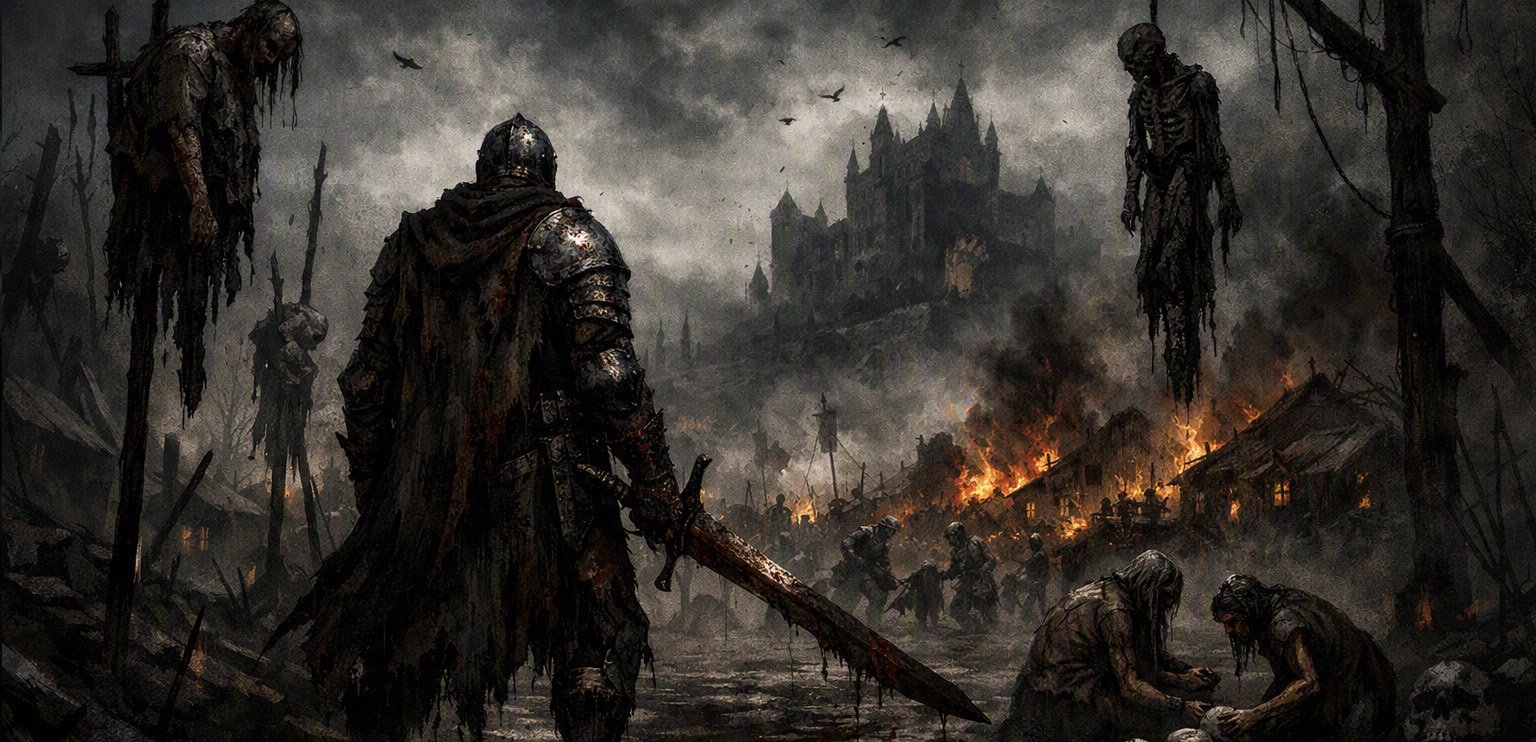
And Why You’ve Been Told the Wrong Story
Here is the criticism you have heard a hundred times: grimdark is darkness for its own sake. It is fiction written by edgelords for edgelords, a parade of rape and torture and moral bankruptcy dressed up as sophistication. It mistakes misery for depth, cynicism for insight, and shock for meaning. You have read this take in think-pieces, in one-star reviews, in Twitter threads that rack up thousands of retweets from people who have never opened an Abercrombie novel. The criticism is not entirely wrong about the worst examples of the genre. But it is catastrophically wrong about what grimdark actually is, at its core and at its best.
Where the Word Came From
The term “grimdark” is a piece of borrowed jargon, lifted from the flavour text of Warhammer 40,000 — a tabletop wargame set in a dystopian far future where the tagline reads, famously, “In the grim darkness of the far future, there is only war.” It was appropriated by fantasy readers in the early 2000s, initially as mild mockery, a way of flagging fantasy fiction that pushed aggressively against the Tolkienian tradition of moral clarity and eucatastrophe — the tradition in which evil is a metaphysical force, good is an identity rather than a practice, and the world’s fate turns on the courage of the righteous. Grimdark said: what if none of that were true? What if good people failed, evil wasn’t a separate category from the people fighting it, and the world turned not on courage but on contingency and power?
In practice, that question had already been asked — for decades, and brilliantly. Glen Cook’s The Black Company (1984) followed mercenaries who were not the heroes of their own story. Michael Moorcock’s Elric had been deconstructing heroic fantasy since the 1960s. Joe Abercrombie’s The Blade Itself (2006) simply arrived at a moment when the internet could name the tradition, argue about it, and grow it into a genuine movement. R. Scott Bakker’s The Prince of Nothing trilogy pushed further — into philosophy, into genuine darkness, into territory that makes some readers deeply uncomfortable and other readers feel seen for the first time.
The Real Argument
Here is what grimdark’s critics get wrong: they assume that the default mode of fantasy — the Tolkienian mode — is neutral, and that grimdark is a deviation. It isn’t. The Tolkienian tradition is a very specific set of ideological commitments: that the world has a moral grain, that heroism is possible and meaningful, that sacrifice leads to restoration, that good and evil are finally distinguishable even when the cost of distinguishing them is high. These are beautiful commitments. They are also, as a description of how human beings actually experience power and war and institutions and each other, wrong.
Grimdark is not pessimism. It is realism applied to fantasy’s conventions. It asks what happens if you take the conventions of epic fantasy — the war, the quest, the throne, the chosen one — and subject them to the same scrutiny you would apply to actual history. What actually happens when armies march? What actually happens to the people in the village the heroes pass through? What actually happens to the soldier who does the things soldiers do, and then comes home? What actually happens to a king? History answers these questions, and the answers are almost never clean.
The Tradition Is Older Than You Think
Grimdark, understood this way, has a long literary pedigree that extends well beyond fantasy. It is what Cormac McCarthy does to the Western in Blood Meridian — he strips the mythology of its consolations and leaves you with what the violence actually was. It is what Dostoevsky does when he refuses to make faith easy, what Conrad does when he refuses to make empire heroic. The willingness to look at what human beings actually do when given power, and to resist the narrative pressure to make that look better than it is — this is not a new impulse. Grimdark is its latest home in popular fiction.
The Charge of Nihilism
The most serious version of the criticism is not that grimdark is gratuitous. It is that grimdark is nihilistic — that by refusing the consolations of heroism and moral clarity, it refuses to stand for anything at all. This is worth taking seriously. A grimdark novel that simply demonstrates that everything is terrible and everyone is compromised and nothing matters is not, in the end, more honest than a heroic fantasy — it is just equally distorted in the opposite direction.
But the best grimdark doesn’t do this. Abercrombie’s characters, for all their compromises, are not indistinguishable from one another in their choices. Bakker’s Kellhus is terrifying precisely because he has evacuated himself of anything like moral feeling — and the novels refuse to frame this as freedom. The darkness in grimdark is not a conclusion. It is a pressure — a pressure that forces characters, and readers, to work harder for whatever meaning they find.
What Grimdark Demands of the Reader
And this is the real answer to the criticism. Grimdark makes demands that heroic fantasy, for all its beauties, does not. It refuses to sort the world into categories for you. It refuses to tell you which character to root for based on narrative position alone. It refuses to guarantee that the thing the characters are fighting for is worth the cost. It makes you do the work of deciding whether it was, which means you have to have a position — a real one, not just the one the story handed you. That is harder. It is also, I would argue, more like reading literature than reading genre, in the best possible sense of that distinction.
Grimdark doesn’t ask you to enjoy the darkness. It asks you to look at it clearly enough that when you find something worth caring about inside it — and you will — you know that you found it yourself.
Joe Sarkic writes award‑winning grimdark fantasy and science fiction, crafting atmospheric tales of haunted realms, fractured megacities, and the people who survive them. Step into Veil of Dawn’s Promise and Necrocracy: Forsaken Guardian to explore worlds where both sorcery and technology demand a price.
Join My World